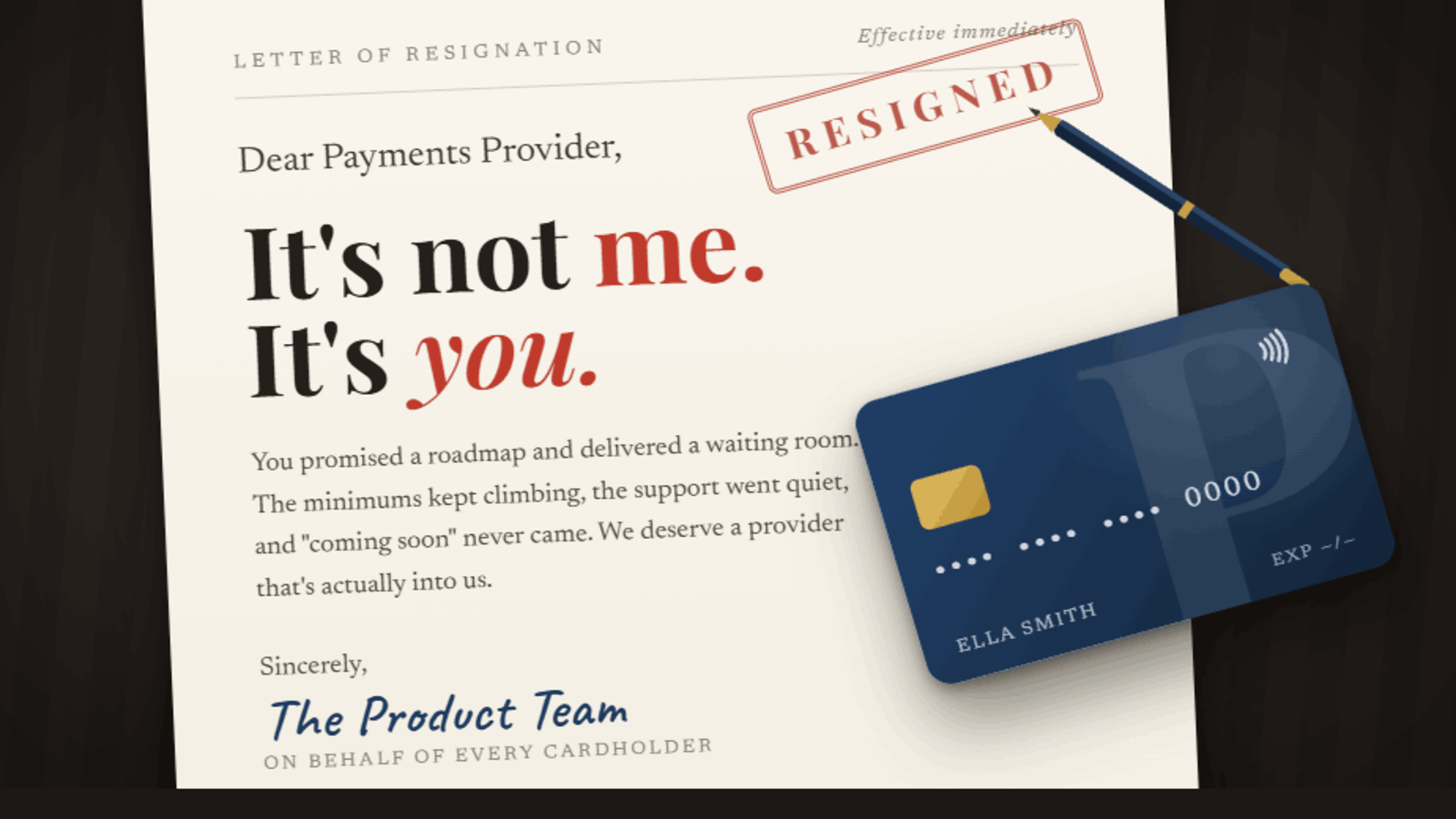

Most companies don't switch payment providers because of a major failure. More often, the decision comes after months of small frustrations that gradually become harder to ignore.
It might start with a feature that takes longer than expected to launch, or a support request that requires repeated follow-up before anything happens.
Over time, the administrative effort needed to keep the program running begins to grow rather than shrink. None of these issues is necessarily serious on its own, which is why many organizations stay with a provider long after the relationship has stopped working.
There's also a practical reason for that hesitation. Changing providers can be disruptive. New contracts, integrations, card replacements, customer communications, and migration planning all require time and effort. Many teams convince themselves that the current situation isn’t that bad because it’s easier than making a change.
The problem is that waiting for a major breakdown isn't always the right approach. In many cases, the warning signs appear long before a program reaches a crisis point.
The five signs below are some of the most common indicators that a provider relationship is no longer serving your business. If any of them sound familiar, it may be time to take a closer look at whether your current provider is still the right fit for your program.
Sign #1: Your Provider Is Backing Out of Card Issuance
Sometimes the clearest sign that it's time to move on is that the decision is no longer entirely yours. The payments industry changes quickly, and a provider that was actively pursuing programs like yours a few years ago may decide that its future lies elsewhere.
Some providers will make the shift obvious, such as announcing that they are discontinuing a product line or withdrawing from a particular market. More often, the warning signs appear gradually.
Warning signs to keep an eye out for include:
- Minimum volume requirements that keep increasing, making it clear that your program is no longer the type of business the provider wants to focus on.
- Renewal conversations that seem to change every year, leaving you uncertain about what your program will look like six or twelve months from now.
- Less investment in the products and services you rely on, while the provider focuses its attention elsewhere.
- Slower support or less engagement from the provider's team, leaving you with the feeling that your program is no longer a priority.
When a provider decides to move away from a product, market, or type of customer, you could be left dealing with:
- Replacing existing cards, which can be expensive, time-consuming, and disruptive for cardholders.
- Interrupted renewal or replacement cycles creating confusion for users and extra work for your team.
- Lost cardholders during the transition, as some people fail to activate replacement cards or simply stop using the program altogether.
- A rushed migration to a new provider, forcing your team to make important decisions under pressure rather than on your own timeline.
Sign #2: Your Provider Is Also Your Competition
A payments provider relationship works best when your provider focuses on delivering the infrastructure, support, and expertise you need to grow your program. That dynamic becomes more complicated when your provider is also competing in the same market.
For example, if you're running a loyalty, rewards, or incentive program, and your provider offers a competing solution to the same customer base. Even if there is no direct conflict, it's fair to ask whether your interests are fully aligned.
The challenge isn't necessarily that your provider is acting in bad faith but rather that competing interests can create competing priorities. When that happens, decisions that should be made with your program in mind may be influenced by broader commercial considerations.
If you're unsure whether this applies to your provider, consider the following questions:
- Does your provider offer a competing product or service? If so, there may be situations where their priorities differ from yours.
- Who benefits most from their product roadmap? New features and investments should support your growth, not just their own strategic objectives.
- How much visibility do they have into your business? Depending on the relationship, your provider may have access to customer, transaction, or program data that could provide valuable market insight to give their business an edge over yours.
- Do you feel like a customer or a competitor? If strategic conversations have become guarded or one-sided, it may be a sign that the relationship has changed.
Sign #3: Their Compliance Problems Are Becoming Your Problem
When a payments provider has strong licenses, registrations, compliance processes, and banking relationships, it's something you rarely need to think about. The problem arises when cracks start to appear.
If a provider loses a banking partner, encounters regulatory issues, or becomes unable to operate in a market that matters to your business, the impact can extend directly to your program. Some warning signs to watch for include:
- Uncertainty around licensing or registration status, particularly in markets where you plan to grow. If a provider cannot legally support your expansion plans, your program may hit unexpected roadblocks.
- Overreliance on a small number of banking relationships. When a provider depends heavily on a single bank or a limited group of partners, disruptions can have a much greater impact on customers and programs.
- Limited transparency about where client funds are held and how they are safeguarded. You should have a clear understanding of how funds are protected and what would happen if a banking or regulatory issue arose.
- Reluctance to discuss compliance, regulatory oversight, or contingency planning. Strong providers are usually comfortable explaining how they manage risk and respond to unexpected events.
Sign #4: You Were Sold a Roadmap, Not a Product
Most teams have heard some version of the same promise: a feature is almost ready, an integration is coming soon, or a capability will be available shortly after launch. Sometimes those promises are delivered, but often they aren't.
The risk is that you end up building your program around functionality that doesn't yet exist. Delays create workarounds, manual processes, and customer frustrations that can be difficult to unwind later.
A roadmap can tell you where a provider is going. Your decision, however, should be based primarily on what they can deliver today. To separate what's available from what's being planned, ask a few simple questions:
- What features are live today? Focus on capabilities that are already in production rather than features that are still on the roadmap.
- Can the provider demonstrate it is working? A demo is valuable, but seeing a capability operating in a real environment is even better.
- Is it documented in the agreement? If a feature is critical to your program, make sure expectations and timelines are clearly defined.
- Can you test it yourself? A sandbox environment can quickly reveal the difference between a mature capability and a future release.
Sign #5: Adoption Is Quietly Failing and Money Sits Unspent
Not every payment program succeeds simply because it's launched. The real test is whether people actually use it. It's easy to assume that users are resistant to change or simply aren't engaging, but adoption problems are often symptoms of a deeper issue. Registration may be too complicated, cardholder communications may be unclear, or the overall user experience may create unnecessary friction.
Consider if any of the following are happening:
- Low activation or registration rates, where a significant number of users never make it past the first step.
- Heavy reliance on manual administration leaving your team to answer questions, troubleshoot issues, and handle tasks that should be largely self-service.
- Frequent user confusion or support requests, which may indicate that the experience is more complicated than it needs to be.
- Large balances remaining unused for extended periods, even though the funds are available and ready to be spent.
What to Do Next: Turn the Signs Into a Screening Tool
The good news is that you don't need to experience all five warning signs before considering a change. One or two recurring issues are enough to justify taking a closer look at whether your current provider is still the right fit. The key is to treat these signs as evaluation criteria rather than isolated frustrations.
As you assess your current provider, consider the following questions:
- Stability: Is the provider committed to the products, markets, and customer segments that matter to your program?
- Neutrality: Are their interests aligned with yours, or do competing priorities create potential conflicts?
- Regulatory standing and fund safeguarding: Do they have the licenses, banking relationships, and compliance foundation needed to support your growth?
- Honesty about capabilities: Are you evaluating what exists today, or what may exist at some point in the future?
- Adoption and user experience: Is the platform making it easy for people to participate, or creating friction that limits results?
Changing providers is rarely anyone's first choice. It requires planning, effort, and careful execution. But staying with a provider that no longer meets your needs carries its own costs.
If several of these warning signs sound familiar, it may be time to start exploring your options. And if you'd like to discuss what a transition could look like, Berkeley Payment Solutions would be happy to help.
