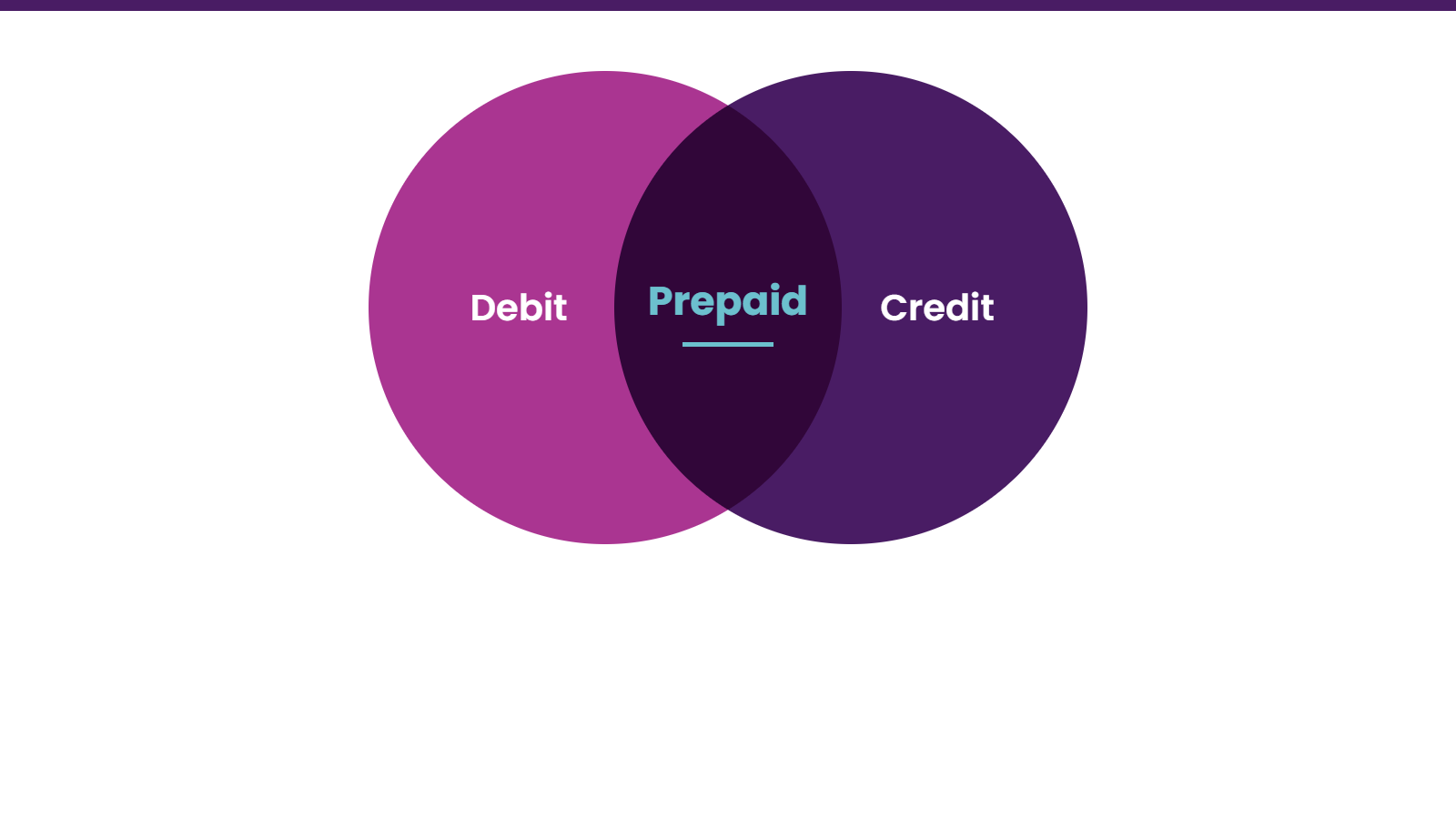

Debit and credit aren't really competitors. They solve different problems. Debit gives people direct access to money they already have. Credit lets them borrow against money they don't. Most companies never weigh one against the other, because the use case usually points clearly to one or the other.
The option that gets missed is the third one. When a company sets out to build a card program, it tends to reach for whichever card type looks closest to the job, or for whatever its bank partner puts in front of it. Prepaid rarely makes the shortlist.
That's not because prepaid lacks functionality. It's because most operators are still working from outdated assumptions about what prepaid can do, how it's funded, and how the economics work.
It's worth being clear on how each option is usually seen. Debit is viewed as the lower-cost, no-frills choice: familiar, straightforward, and tied to available funds. But for program owners, it comes with limited revenue upside and network economics that may not actually support the business case. Credit is seen as the profitable one, generating interchange, interest, and fee income. But that revenue carries a heavy operating burden: underwriting, lending risk, collections, charge-offs, capital requirements, and regulatory complexity.
Prepaid sits outside that framing, and that's exactly why it gets skipped. In reality, prepaid programs can capture many of the cost advantages of debit-like rails while avoiding some of the biggest debit limitations, and without inheriting the lending, collections, and capital requirements that come with credit.
For companies building payment, payout, payroll, rewards, or account-access programs, prepaid deserves a much closer look.
Prepaid functionality is like a bank account
One of the most common misconceptions about prepaid is that it always requires a cardholder or program owner to manually load funds in advance of a purchase.
In that model, the card is only useful once value has been pushed onto the account. If the balance is too low, the transaction fails. If too much money is loaded too early, funds sit idle on the card until they're spent.
That model still exists, and it works well for many use cases. But it isn't the only way prepaid can function.
With the right processor-level configuration, a prepaid program can support a far more dynamic funding experience. Instead of requiring funds to sit on the card long before a purchase is made, a secondary authorization can happen at the processor level. When the cardholder initiates a transaction, the system checks the funding source in real time, approves the transaction, and draws down the funds at the point of spend.
For the end cardholder, the card simply works like a debit card, whether at the point of sale, online, or in a mobile wallet. For the program owner, the benefits are operational and financial: better cash management, less idle value sitting on cards, and a smoother experience for customers.
This matters most for programs where funds are tied to earned wages, benefit balances, disbursements, health spending accounts, disaster relief, or any other use case where timing is everything. Connecting authorization, balance logic, and funding movement in real time changes the role prepaid can play. It shifts prepaid from a stored-value instrument to a function of a broader account-access strategy.
Prepaid vs. debit: the economics most operators miss
The debit versus prepaid comparison is often misunderstood because buyers tend to focus on user experience rather than program economics.
From a cardholder's perspective, debit and prepaid cards can look almost identical. Both spend available funds. Both can support physical cards, virtual cards, mobile wallets, ATM access, bill pay, and transaction history. Both can be tied to an account-like experience.
For the program owner, though, the economics can be very different. There are two sides to weigh: the cost to run the program and the revenue the program can generate.
With debit, especially in traditional bank-linked environments, the program owner pays to access the rails and gets little to no meaningful interchange revenue back. That can turn debit into close to a pure cost center. It enables transactions, but it doesn't necessarily create enough revenue to offset the operational, processing, compliance, and support costs of running the program.
Prepaid programs that run over Visa or Mastercard rails work differently, and they open better opportunities for revenue. Depending on the market, issuer, network, program type, and regulatory structure, prepaid transactions can generate percentage-based interchange that helps offset, or even exceed, the cost of operating the program.
US vs. Canada distinction
In the United States, debit interchange economics are shaped by the Durbin Amendment and Regulation II. The Federal Reserve's Regulation II sets standards for debit card interchange and exempts issuers with less than $10 billion in assets from the interchange fee limits. So the economics of a card program aren't determined solely by whether the card is "debit" or "prepaid." They're also affected by the issuing bank, its asset size, and how the program is structured.
In Canada, the distinction is more closely tied to network models. Debit programs in Canada run on Interac, which operates on a fee model. Instead of percentage-based interchange, merchants pay a fee per transaction regardless of size. That keeps costs down for merchants, but it doesn't serve as a strong revenue source for card operators. Prepaid cards on the Visa and Mastercard rails do let programs earn interchange.
The bottom line: a debit card isn't automatically cheaper or more profitable for the program owner, and a prepaid card isn't automatically limited or costly. The actual economics depend on the issuing structure, network model, bank partner, and more. Many operators default to legacy debit assumptions and never evaluate whether a prepaid structure could deliver better unit economics. That can be a costly oversight.
Prepaid vs. credit: why prepaid belongs in the "low-cost rail" conversation
Credit cards can be powerful revenue engines. Income can come from interchange, annual fees, late fees, interest income, and revolving balances. For large issuers with scale, underwriting capabilities, and mature servicing infrastructure, credit can be highly profitable.
But for smaller players, it's worth remembering that credit is a lending product. A credit card program exposes the program owner to credit risk.
Cardholders spend borrowed money. Some revolve balances and pay interest. Others become delinquent. Some balances have to be charged off. That means the business needs underwriting policies, risk models, collections infrastructure, debt servicing, regulatory oversight, and enough capital to support the receivables.
For some organizations, that trade-off makes sense and is well worth it. For many others, it doesn't.
Prepaid avoids the lending layer entirely. Cardholders spend funds that have already been allocated or made available through the program.
There's no revolving balance, no cardholder debt, no credit line to manage, and no collections relationship to maintain. A prepaid program can support payments, payouts, incentives, employee access, benefit distribution, or customer account access without creating liability tied to cardholder default. An organization can deliver a branded card experience without becoming responsible for customer lending operations.
Too often, companies frame debit as the "safe but low-upside" option and credit as the "profitable but complex" one. Prepaid breaks that framing. It offers more economic upside than many debit programs, and it stays structurally simpler and lower-risk than credit.
The economics of scale: why credit is harder to do well
Credit card programs are far more likely to be profitable for larger organizations because the economics depend on scale. To work, a credit program needs enough cardholders, enough transaction volume, the right mix of transactors and revolvers, disciplined underwriting, strong servicing, and sufficient receivables to support the lending model.
One of the key variables is the roll rate, the percentage of balances that revolve and generate interest revenue. If too few cardholders revolve, the program leans too heavily on interchange. If too many revolve or become delinquent, credit losses erode profitability. The issuer needs the right balance between usage, repayment behavior, interest income, and risk.
Prepaid doesn't need to clear the same lending-scale threshold to work financially.
Because it doesn't involve extending credit, there's no need to build a receivables book, reserve for credit losses, or stand up the same level of collections and servicing infrastructure. The economics can work at a much lower bar, because the program monetizes payments activity, fees, and interchange rather than lending revenue.
None of this means prepaid is simple. A prepaid program still requires the right bank partner, processor, compliance controls, KYC, fraud monitoring, ledgering, reporting, reconciliation, cardholder support, and program governance. But the risk profile is fundamentally different, and the program doesn't rely on lending scale to become viable.
Prepaid is the option most operators skip
Prepaid isn't the right answer for every card program.
There are cases where debit is the best fit, and cases where credit is the right strategic choice. If the goal is to build a lending portfolio, monetize revolving balances, or offer credit as a core customer value proposition, then credit may be the appropriate model. If the goal is direct access to an existing bank account, debit may be the right structure.
But prepaid often stays under-considered because many would-be program operators are working from old assumptions. They assume prepaid means manual loading and can't support an account-like experience. They think debit is always cheaper and credit is the only card model with meaningful revenue potential. They assume prepaid is limited to gift cards, rebates, or one-time incentives.
The truth is that prepaid can do much more. It can support real-time or transaction-funded loading models. It can give cardholders flexible access to funds. It can create better cash management for program owners. It can generate interchange economics that improve the business case. And with the right platform, it can be configured for a wide range of use cases, from payroll and gig worker payments to rewards, disbursements, account access, and emergency relief.
As more program owners understand the economics, prepaid will show up more often in program design conversations that currently default to a debit or credit card. For organizations building a card program, the smarter question isn't "debit or credit?" It's "which payment structure gives us the right balance of cost, revenue, risk, control, and user experience?"
In more cases than you'd think, prepaid is the answer.
To explore whether prepaid is the right structure for your next card program, get in touch with the Berkeley team.
