
The operation behind your payment program.
Launching a payment program takes planning, coordination and execution. Keeping it running takes ongoing work across processing, funding, compliance, reconciliation, customer support and partner coordination.
Berkeley brings the technology, people and operational experience to support your program from initial design through launch and ongoing operation.
On this page
Responsibility
Know who is responsible for what.
A payment program involves several organizations. Each has a role, and those responsibilities should be clear from the outset.
Sponsor bank
Provides the applicable banking and issuing relationship and maintains the bank-controlled funds environment.
Networks and payment rails
Provide the infrastructure, operating rules and services that support card transactions and account-to-account payments. This can include card networks such as Visa and Mastercard, as well as payment systems and rails such as ACH, EFT and Interac.
Berkeley
Provides the technology, processing, ledger, program management, operational and compliance-related services included in the agreed program scope.
Your organization
Owns the product, customer relationship, commercial model and responsibilities assigned to your business.
Implementation
From program design to go-live.
Launching a payment program involves more than connecting an API. The product, banking arrangements, cardholder experience, funding flows, technology and operating processes all need to come together.
Berkeley works with your team and relevant partners to move from initial requirements through configuration, approvals, testing and launch.
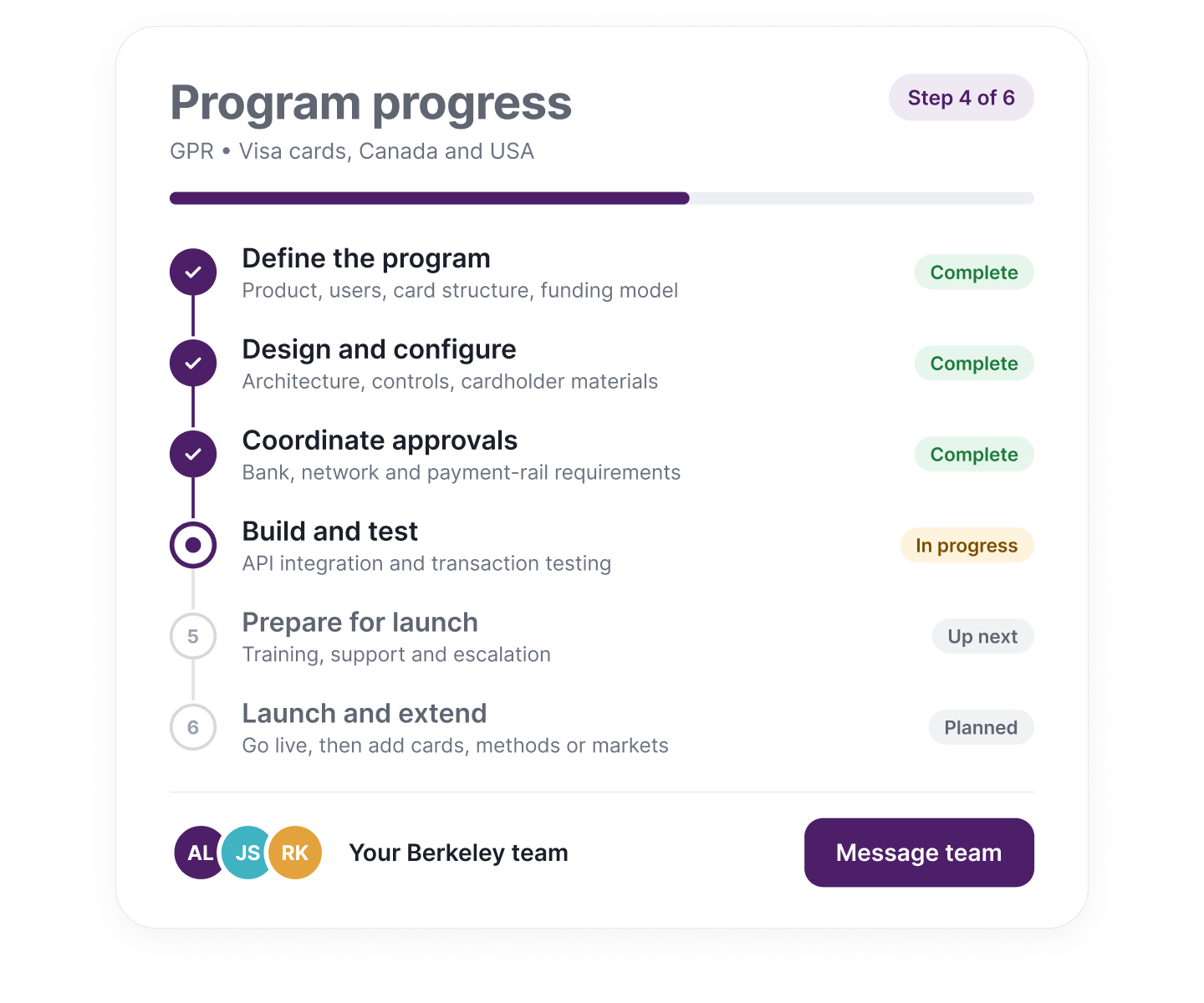
1. Define the program
Establish the product, target users, countries, card structure, funding model, money movement requirements, ledger approach, customer experience and operating responsibilities.
2. Design and configure
Define the program architecture, configure products and controls, prepare card and cardholder materials, and establish the required integrations and workflows.
3. Coordinate approvals
Prepare and submit applicable documentation, coordinate bank, network and payment-rail requirements, and address applicable approvals before launch.
4. Build and test
Complete backend configuration, processor and card production setup, API integration, transaction testing and operational workflow validation.
5. Prepare for launch
Complete training, confirm responsibilities, establish support and escalation processes, and prepare the teams involved in running the program.
6. Launch and extend
Bring the program into operation, then support future changes such as additional card types, payment methods, account structures or markets as the program permits.
Managed operations
A program is a standing operation.
The right infrastructure gets a payment program started. The right operating model keeps it working.
A live payment program creates responsibilities every day. From routine processing and funding to unexpected exceptions, the operation needs clear processes, experienced people and defined ownership.
Berkeley brings together the technology, relationships and people behind your program, giving your team a clear counterpart for the work you don't want to build and staff yourself.
Core operating responsibilities
Card and account issuance
Funding and money movement
KYC, KYB and onboarding processes
Transaction processing
Disputes and chargebacks
Fraud and risk operations
Cardholder servicing
Reconciliation and reporting
Bank, network and payment-rail coordination
Ongoing program administration
Program migration
Move an existing program with a plan for continuity.
Switching payment providers is different from launching something new. Existing programs have cardholders, balances, integrations, transaction history, operating processes and customer expectations that need to be considered throughout the transition.
Berkeley works with your team and relevant partners to plan and manage the migration around the requirements of the existing program.
Discovery
Understand the current architecture, providers, integrations, program rules, transaction flows, card base, balances, data and support model.
Migration design
Define the target operating model, integration approach, data requirements, cutover sequence, testing plan and responsibilities across the parties involved.
Testing and transition
Validate the new environment, coordinate readiness across the client and relevant partners, and plan the transition around the specifics of the program.
Continuity planning
Plan the cutover to keep disruption to cardholders, payment activity, balances, integrations and business operations to a minimum.
Migration experience
4
BIN migrations completed
Under 5 months
Average migration timeline
300%
Faster processing speeds
Named support
A named team for your account.
Payment programs create enough complexity without making your team figure out who to contact when something needs attention.
People who know your program
Clients work with designated contacts who understand their account, requirements, history and the decisions behind the program.
Operational continuity
A long-running payment program builds up knowledge over time. Maintaining that context helps teams handle routine work and exceptions without repeatedly starting from the beginning.
Escalation with context
When an issue requires investigation or a decision, your team has a defined path to the people responsible for the relevant part of the operation.
Tell us what you want to launch.
Tell us what you're building, where it needs to operate and how the money needs to move. We'll help identify the right program and the infrastructure behind it.
Specific services, timelines and responsibilities depend on program scope, agreements, partner requirements and applicable regulations.