
Know who owns what.
Payment programs require clear ownership of regulatory obligations and financial crime controls.
Berkeley supports applicable compliance requirements through customer and business verification, sanctions screening, transaction monitoring and ongoing oversight, with responsibilities defined by each program and its operating environment.
On this page
Who owns what
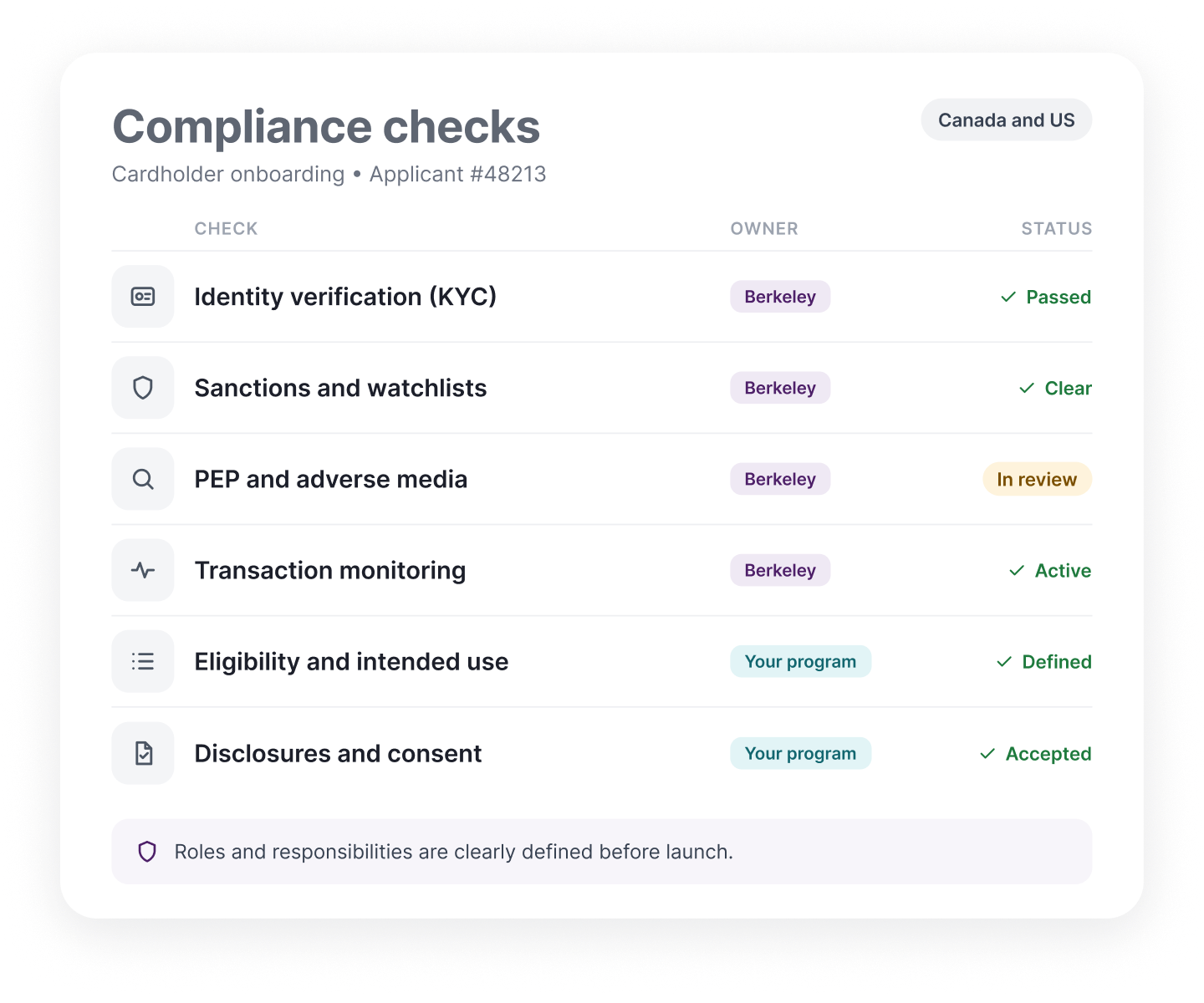
Responsibilities are set for each program before launch, based on its structure and the contractual arrangement.
What Berkeley owns
For the services Berkeley provides, our responsibilities include applicable compliance processes and operational controls, such as:
Customer and business verification
Sanctions and watchlist screening
Transaction monitoring and unusual activity reviews
Investigation, documentation and escalation
Compliance record keeping
Program-level funding and transaction controls
Supported by internal procedures, compliance oversight and coordination with our financial institution partners.
What the client owns
Clients retain responsibility for the obligations associated with their own business, customer relationships and use of the program. Depending on the arrangement, this may include:
Understanding the regulatory requirements applicable to their business and products
Defining program purpose, customer eligibility and intended use
Providing accurate customer, business and transaction information
Meeting applicable obligations related to customer communications, disclosures and consent
Maintaining internal controls and processes outside Berkeley's scope of services
Supporting compliance across Canada and the United States
Berkeley's compliance operating model supports payment programs operating across Canadian and US regulatory environments.
Canada
Berkeley's applicable compliance processes support anti-money laundering and anti-terrorist financing requirements under Canada's Proceeds of Crime (Money Laundering) and Terrorist Financing Act and associated regulations, including relevant FINTRAC requirements. Payment activities may also be subject to requirements under the Retail Payment Activities Act (RPAA), where applicable.
United States
For US programs, Berkeley's compliance processes support applicable Bank Secrecy Act (BSA) and anti-money laundering requirements, including relevant FinCEN requirements.
Across both markets, the specific obligations depend on Berkeley's role, the services provided, the program structure and the responsibilities of the participating financial institution.
Compliance controls built into program operations
The specific controls and processes applied to a program depend on its design, risk profile and applicable requirements.
KYC and KYB
Customer and business verification is incorporated into applicable onboarding workflows. Requirements depend on the type of customer, program structure, jurisdiction and financial institution partner.
Sanctions and watchlist screening
Berkeley screens corporate clients and cardholders against applicable sanctions and regulatory lists as part of relevant onboarding processes. Ongoing screening is also performed according to program requirements.
Screening may incorporate politically exposed person (PEP) information, adverse media and other relevant risk information, depending on the program. Potential matches are reviewed by the Compliance team, documented and escalated where appropriate.
Program-level transaction controls
Programs can be configured with controls that govern how funds are loaded, transferred and spent. Depending on the program, these may include:
Funding and transaction velocity limits
Minimum and maximum balances and load amounts
Transfer restrictions
Merchant category and geographic restrictions
International transaction settings
ATM access and withdrawal limits
Transaction amount and frequency controls
Controls are established during implementation. Changes are reviewed through an established process, with financial institution approval where required.
Transaction monitoring
Berkeley uses transaction monitoring capabilities, processor-provided reporting and internal reviews to identify activity that may warrant further investigation.
Monitoring considers patterns such as unusual transaction volumes or frequency, rapid movement of funds, activity inconsistent with expected program use and other indicators of potentially suspicious activity.
Unusual activity investigation and escalation
Potentially unusual or suspicious activity is reviewed by Berkeley's Compliance team. Investigations may involve reviewing transaction history, customer information and supporting documentation, with additional research where appropriate.
Findings are documented and escalated to management and financial institution partners as required. Berkeley's internal reporting processes support partner-bank review and applicable regulatory reporting obligations.
Define the compliance boundary before launch.
No two payment programs have exactly the same compliance requirements.
Product design, customer relationships, funding arrangements, operating jurisdictions and financial institution partners all influence how responsibilities are allocated.
Berkeley works with clients to establish the requirements and responsibilities associated with each program before launch, helping ensure the operating model is understood from the outset.
Security and assurance
Compliance is one part of operating a payments infrastructure business. Berkeley also maintains security controls and independent assessments designed to protect the systems, data and payment environments that support client programs.
Talk through your program.
Tell us what you're building, where it needs to operate and how the program will be funded and used. We'll help establish the right operating model and the responsibilities behind it.
Tell us what you want to launch.
Tell us what you're building, where it needs to operate and how the money needs to move. We'll help identify the right program and the infrastructure behind it.